

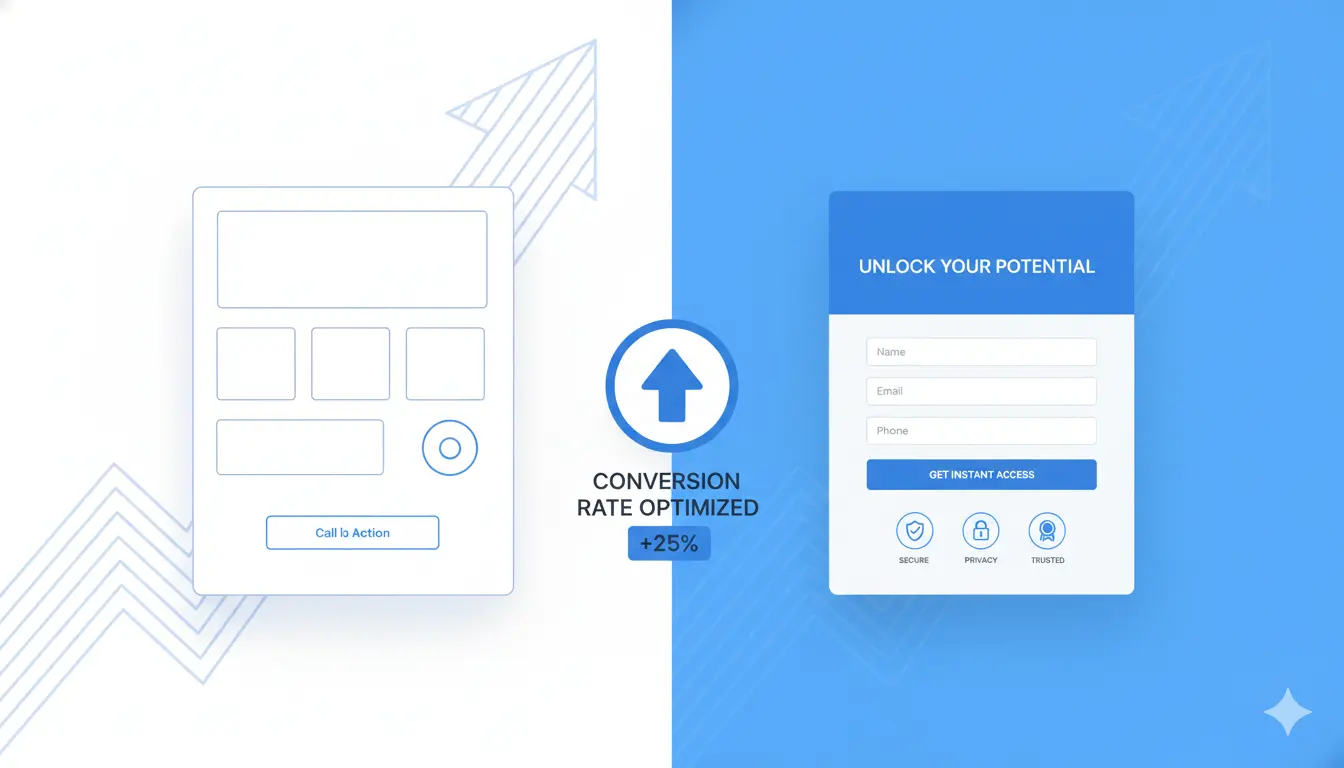
Introduction: Why Your Website Design Directly Impacts Lead Generation
Your website is more than just a digital business card—it’s your 24/7 sales representative, lead qualification tool, and conversion engine all rolled into one. According to HubSpot research, 75% of users admit to making judgments about a company’s credibility based on website design alone. This means that every pixel, color choice, button placement, and loading second directly impacts your ability to capture leads and grow your business.
In today’s competitive digital landscape, simply having a website isn’t enough. You need a strategically designed conversion machine that guides visitors through a clear journey from awareness to action. Whether you’re a B2B service provider, e-commerce store, or local business, implementing proven web design strategies can dramatically increase your lead generation results.
This comprehensive guide explores actionable web design strategies that transform casual visitors into qualified leads, backed by data-driven insights and real-world examples you can implement today.
Strategy 1: Implement Clear, Compelling Value Propositions Above the Fold
The Psychology of First Impressions
Visitors decide within 3-5 seconds whether to stay on your website or leave. Your above-the-fold content—the section visible without scrolling—must immediately communicate who you are, what you offer, and why visitors should care.
According to Nielsen Norman Group research, users spend 80% of their time looking at information above the fold. This prime real estate should answer three critical questions:
- What do you do? (Clear service/product offering)
- Who is it for? (Target audience identification)
- Why should I choose you? (Unique value proposition)
Actionable Implementation Tips
Craft a Benefit-Focused Headline Instead of generic statements like “We Provide Digital Marketing Services,” use benefit-driven headlines like “Grow Your Business 3X Faster with Data-Driven Marketing Strategies.”
Support with Compelling Subheadings Expand on your headline with 1-2 sentences that elaborate on your value proposition. Include specific outcomes, timeframes, or differentiators that set you apart from competitors.
Use Hero Images That Reinforce Your Message Choose visuals that directly support your value proposition rather than generic stock photos. Show your product in action, happy customers, or visual representations of benefits.
Example: Dropbox famously increased conversions by 10% simply by changing their hero image from a generic screenshot to an illustration that clearly explained their file-syncing service.
Strategy 2: Optimize Call-to-Action (CTA) Placement and Design
Understanding CTA Psychology
Calls-to-action are the conversion engines of your website. Every page should have a clear, primary CTA that guides visitors toward the next step in your funnel. Research from WordStream shows that websites with clear CTAs can see conversion rate improvements of up to 200%.
CTA Best Practices for Maximum Conversions
Use Action-Oriented, Benefit-Focused Language Instead of generic “Submit” or “Click Here” buttons, use action verbs that communicate value:
- ✅ “Get My Free Strategy Session”
- ✅ “Download the Complete Guide”
- ✅ “Start My 14-Day Free Trial”
- ❌ “Submit” or “Click Here”
Implement Strategic Color Contrast Your CTA buttons should stand out from surrounding elements through color contrast. According to HubSpot, using contrasting colors can increase CTA visibility by up to 80%.
Place CTAs at Natural Decision Points Position CTAs where users have consumed enough information to feel confident taking action:
- After explaining key benefits
- Following social proof or testimonials
- At the end of blog posts or resource pages
- In website headers and sticky navigation bars
Test Multiple CTA Variations Implement A/B testing to determine which CTA copy, colors, and placement work best for your audience. Tools like Google Optimize or Optimizely can help you run systematic tests.
Strategy 3: Leverage Social Proof and Trust Signals
Building Credibility Through Third-Party Validation
Trust is the currency of online conversions. Visitors won’t provide their contact information unless they believe you can deliver on your promises. Social proof elements provide third-party validation that reduces perceived risk and increases conversion likelihood.
According to BrightLocal, 87% of consumers read online reviews for local businesses, and positive reviews can increase conversion rates by up to 270%.
Essential Trust Elements to Include
Customer Testimonials with Specific Results Generic testimonials like “Great service!” are less effective than specific, result-oriented feedback:
“Working with Rohit increased our organic traffic by 150% in just 3 months. His strategic approach to SEO delivered measurable ROI from day one.”
— Sarah Johnson, Marketing Director at TechStart Inc.
Client Logos and Case Studies Display logos of recognizable clients or partners to build instant credibility. For B2B businesses, detailed case studies with metrics and ROI data are particularly powerful.
Trust Badges and Security Seals Include SSL certificates, payment security badges, industry certifications, and privacy policy links to reassure visitors their information is safe.
Media Mentions and Press Coverage Showcase logos or links from publications that have featured your business to establish authority and legitimacy.
Strategy 4: Create High-Converting Lead Capture Forms
The Science of Form Optimization
Forms are where visitors become leads, making form design critical to conversion success. However, longer forms typically see lower completion rates—each additional form field can reduce conversions by up to 15% according to Formstack research.
Form Optimization Best Practices
Minimize Required Fields Only ask for essential information needed to qualify and follow up with leads. For top-of-funnel offers, stick to 3-4 fields maximum (name, email, company).
Use Smart Progressive Profiling For returning visitors, pre-fill known information and ask for additional details over time rather than all at once.
Implement Clear Error Messaging Provide real-time validation and helpful error messages that guide users toward successful form completion rather than generic “error” alerts.
Optimize Form Placement and Design
- Use contrasting colors for form fields and submit buttons
- Ensure adequate spacing between fields
- Make forms mobile-friendly with large tap targets
- Consider multi-step forms for longer information collection
Example: Unbounce found that reducing form fields from 11 to 4 increased conversions by 120% while maintaining lead quality.
Strategy 5: Implement Strategic Visual Hierarchy
Guiding the Eye Through Design
Visual hierarchy uses size, color, contrast, and spacing to guide visitors’ attention toward the most important elements on your page. Without clear visual hierarchy, visitors become overwhelmed and leave without taking action.
Visual Hierarchy Principles for Conversion
Size and Scale Larger elements naturally draw more attention. Make your headline, primary CTA, and key benefits the largest elements on the page.
Color and Contrast Use contrasting colors to highlight important elements like CTAs, while maintaining a cohesive color palette that aligns with your brand.
Whitespace (Negative Space) Adequate spacing around elements reduces cognitive load and makes content more scannable. Cluttered pages overwhelm visitors and increase bounce rates.
Typography Hierarchy Establish clear relationships between headings, subheadings, and body text through font size, weight, and style variations.
Directional Cues Use arrows, lines, or imagery that points toward CTAs to guide visitor attention naturally.
Strategy 6: Optimize for Mobile-First Experiences
The Mobile Conversion Imperative
With 60% of global website traffic coming from mobile devices (Statista, 2024), mobile optimization is no longer optional—it’s essential for lead generation success. Google’s mobile-first indexing means your mobile site performance directly impacts search rankings and visibility.
Mobile Optimization Checklist
Implement Responsive Design Ensure your website adapts seamlessly to different screen sizes and orientations without requiring horizontal scrolling or zooming.
Optimize Touch Targets Make buttons and interactive elements at least 44×44 pixels to accommodate finger tapping and prevent accidental clicks.
Simplify Mobile Navigation Use hamburger menus, sticky navigation, or bottom navigation bars to make site exploration easy on small screens.
Accelerate Mobile Page Speed Mobile users have less patience for slow-loading pages. Optimize images, minify code, and leverage browser caching to achieve load times under 3 seconds.
Streamline Mobile Forms Use mobile-friendly input types (email keyboards, number pads), implement autofill where possible, and minimize typing requirements.
Strategy 7: Use Exit-Intent Popups Strategically
Capturing Leaving Visitors
Exit-intent technology detects when visitors are about to leave your website and displays targeted offers to encourage them to stay and convert. According to OptinMonster, exit-intent popups can recover up to 15% of abandoning visitors.
Effective Exit-Intent Strategies
Offer Irresistible Lead Magnets Provide valuable resources like ebooks, checklists, templates, or free consultations in exchange for contact information.
Create Urgency with Limited-Time Offers Use time-sensitive language like “Limited spots available” or “Offer expires in 24 hours” to encourage immediate action.
Segment Offers Based on Page Content Display relevant offers based on the page visitors are leaving. Someone reading a blog post about SEO should see an SEO audit offer, not a generic newsletter signup.
Test Timing and Frequency Avoid showing popups too early or too frequently, which can frustrate visitors. Test different trigger points to find the optimal balance.
Strategy 8: Implement Live Chat for Instant Engagement
Real-Time Lead Qualification
Live chat provides immediate assistance to visitors with questions, reducing friction and increasing conversion likelihood. Drift reports that businesses using live chat see conversion rate increases of 20-40%.
Live Chat Best Practices
Use Proactive Engagement Triggers Initiate conversations based on visitor behavior like time on page, pages viewed, or exit intent rather than interrupting immediately.
Provide Clear Value in Chat Invitations Instead of generic “Can I help you?” messages, use value-focused invitations:
- “Need help choosing the right plan?”
- “Want a free website audit?”
- “Have questions about our services?”
Integrate with CRM Systems Connect live chat to your CRM to automatically create leads and track conversations for follow-up.
Offer Chatbot Options for After-Hours Implement AI-powered chatbots to capture leads and answer common questions when human agents aren’t available.
Strategy 9: Create Dedicated Landing Pages for Campaigns
Focused Conversion Environments
Landing pages are standalone web pages designed for a single conversion goal, free from navigation distractions and competing CTAs. Unbounce found that dedicated landing pages can increase conversions by up to 25% compared to homepage redirects.
Landing Page Essentials
Single, Clear Conversion Goal Each landing page should focus on one specific action—newsletter signup, demo request, ebook download, etc.
Remove Navigation Distractions Eliminate main navigation menus to keep visitors focused on your conversion goal.
Match Ad Messaging to Landing Page Content Ensure consistency between your advertising copy and landing page messaging to reduce cognitive dissonance and increase trust.
Include Only Essential Elements Every element on your landing page should support your conversion goal. Remove unnecessary links, images, or content that doesn’t directly contribute to conversion.
Strategy 10: Leverage Video Content for Higher Engagement
The Power of Visual Storytelling
Video content can dramatically increase engagement and conversion rates. According to Wyzowl, 86% of businesses use video as a marketing tool, and landing pages with video see 80% higher conversion rates than those without.
Effective Video Strategies
Product/Service Explainer Videos Create short (60-90 second) videos that clearly explain what you offer and how it benefits customers.
Customer Testimonial Videos Video testimonials are more authentic and engaging than text-based reviews, building stronger emotional connections.
Behind-the-Scenes Content Show your team, process, or company culture to humanize your brand and build trust.
Live Demo or Webinar Recordings Offer valuable educational content that demonstrates your expertise while capturing leads.
Measuring and Optimizing Your Conversion Strategy
Key Metrics to Track
Conversion Rate The percentage of visitors who complete your desired action. Industry averages vary by business type, but aim for continuous improvement.
Bounce Rate The percentage of visitors who leave after viewing only one page. High bounce rates indicate messaging or design issues.
Average Session Duration How long visitors spend on your site. Longer sessions typically indicate higher engagement and interest.
Lead Quality Metrics Track which sources and pages generate the highest-quality leads that convert to customers.
Continuous Optimization Process
- Establish Baseline Metrics – Measure current performance before making changes
- Identify Opportunities – Use heatmaps, session recordings, and user feedback to find friction points
- Implement Changes – Make data-driven improvements to design and content
- Test and Measure – Use A/B testing to validate changes and measure impact
- Iterate and Improve – Continuously refine based on performance data
Conclusion: Building a Conversion-Focused Website
Transforming your website into a lead generation powerhouse requires strategic design choices, psychological understanding, and continuous optimization. By implementing these proven web design strategies—from clear value propositions and optimized CTAs to trust signals and mobile-first experiences—you can dramatically increase your ability to convert visitors into qualified leads.
Remember that conversion optimization is an ongoing process, not a one-time project. Regularly test, measure, and refine your approach based on real user data and changing market conditions. The businesses that consistently outperform competitors are those that treat their website as a dynamic, evolving asset rather than a static brochure.
Ready to transform your website into a lead generation machine? Start implementing these strategies today and watch your conversion rates soar.